The story ends. The adventure doesn’t have to.
 3 min read
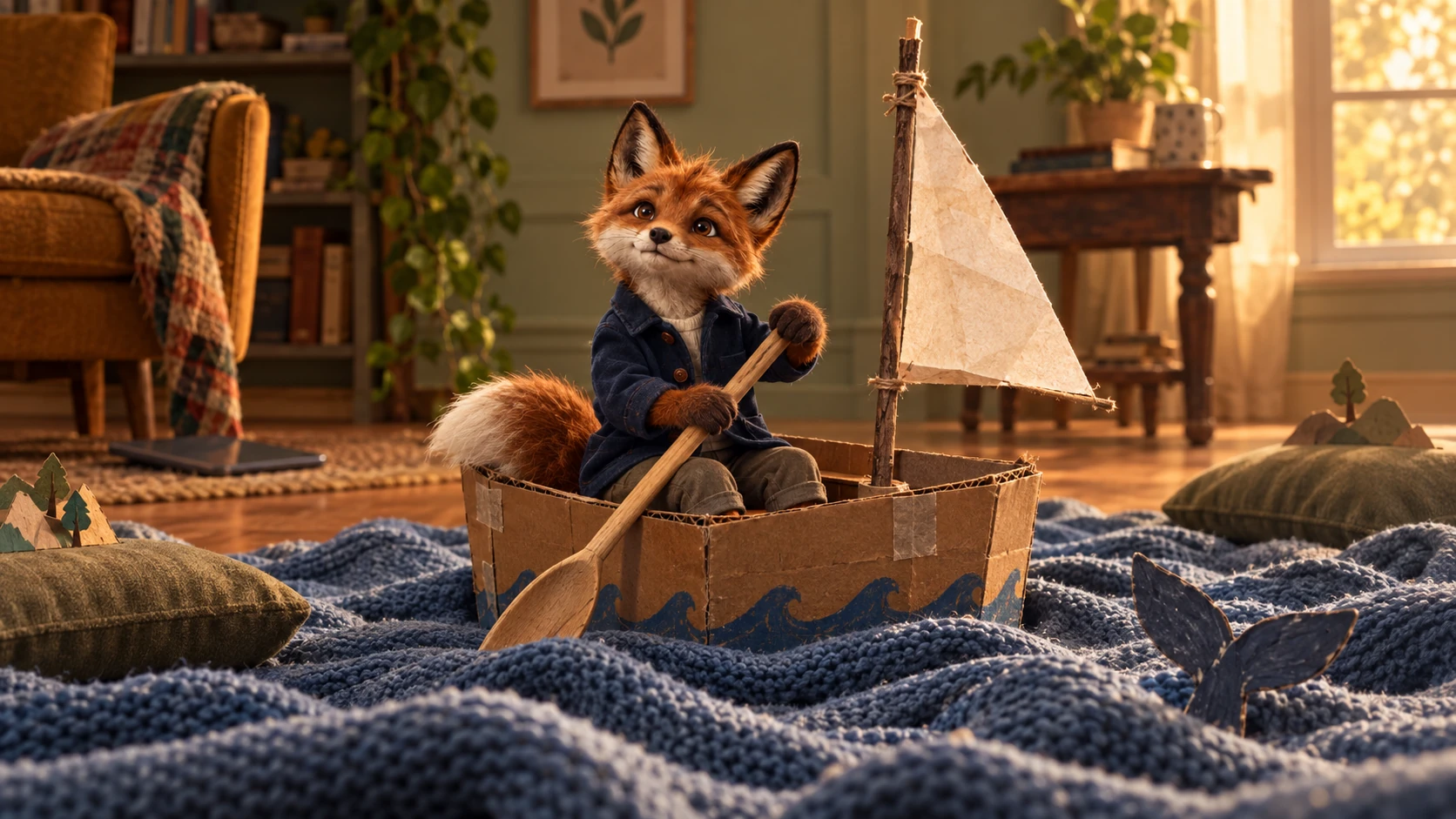
Let them decide what happens next.
Imagine a child announcing that the dragon from the story now runs a grocery store. The dragon still breathes fire. It just needs somewhere to put the oranges.
There is a choice for the adult here. Ask how that fits the ending, or ask whether the shop needs a customer.
Our preference is the second. When reading turns into play, the child gets to change the material. A passing detail can become the whole adventure. You can join without knowing where it is going.
That invitation has a useful boundary: it is optional. NAEYC’s guidance on early childhood practice places choice, wonder and delight at the heart of play, and cautions that an activity becomes less likely to feel like play as adult direction increases. [2]
Start with a detail they kept.
You do not need an activity prepared before you start reading. Afterward, notice what the child returns to: the bridge, the peculiar hat, the character who never got a turn to speak.
Try one question: “What would you do if you were there?” Then give the answer time to arrive. If they say they would leave immediately, that is a beginning, too.
Or make a small invitation without a question. Place a cushion beside you and say, “This could be the island.” Let them accept it, change it or carry on with something else.
If the response is “Read it again,” you already have your next activity.
Give an ordinary object a new job.
A spoon makes a satisfying boat oar. A cushion can be the only dry land for miles. A cardboard box leaves plenty of room for disagreement about whether it is a ship, a cave or the dragon’s shop.
In its guidance for parents of toddlers, ZERO TO THREE describes this use of one object to stand for another as symbolic thinking. It recommends simple pretend-play props, including boxes, blankets and pillows, while encouraging adults to follow the child’s lead. [3]
For your own invitation, choose a couple of familiar objects. You can offer a spoon and a cushion without arranging an entire ocean. Ask, “What could this be?” before telling the child what you had in mind.
Keep their answer. The spoon may have a more important appointment as a telephone.
Take the part they give you.
Once the game has begun, there is no need to keep supplying ideas. You might be asked to hold the sail, buy the oranges or stand very still because you are now a tree.
Before adding a twist, find out what the child has already decided. “Where should I stand?” often does more for the game than a fresh plot.
If you need help joining in, describe something visible: “You’ve moved the island.” That gives the child an opening to explain, correct you or keep playing. You do not have to fill every quiet moment.
NAEYC describes adults supporting play through comments and questions while children continue to lead. [2]
The play does not have to prove anything.
It is tempting to justify every pleasant childhood activity by what it might develop. A major review of pretend-play research, published online in 2012, found that the evidence did not support strong claims that pretend play uniquely causes broad developmental benefits. That conclusion is a reason to be careful about promises; it is not a reason to put the cardboard ship away. [1]
Our reason for making this invitation is simpler: a child may enjoy deciding what happens to an idea they have just encountered. The story can become something they have a say in.
Some afternoons the game will grow. On others, the cushion will remain a cushion. You can finish reading, put things away and have had a good time together.
And if the dragon opens for business, you can ask what the oranges cost.
After your next story, offer one familiar object and ask, “What could this be?” Follow the child’s answer, including “nothing.”
Sources & further reading
- The Impact of Pretend Play on Children’s Development: A Review of the Evidence · Psychological Bulletin / American Psychological Association
- Developmentally Appropriate Practice: A Position Statement of the National Association for the Education of Young Children · National Association for the Education of Young Children
- From Baby to Big Kid: Month 32 · ZERO TO THREE
Created with AI-assisted research and writing, with editorial and source checks. Reviewed for publication by the Storytailor owner. The illustration is an imagined scene.