How to Listen to a Child’s Invented Spaceship Name
 4 min readUpdated
Begin with the name
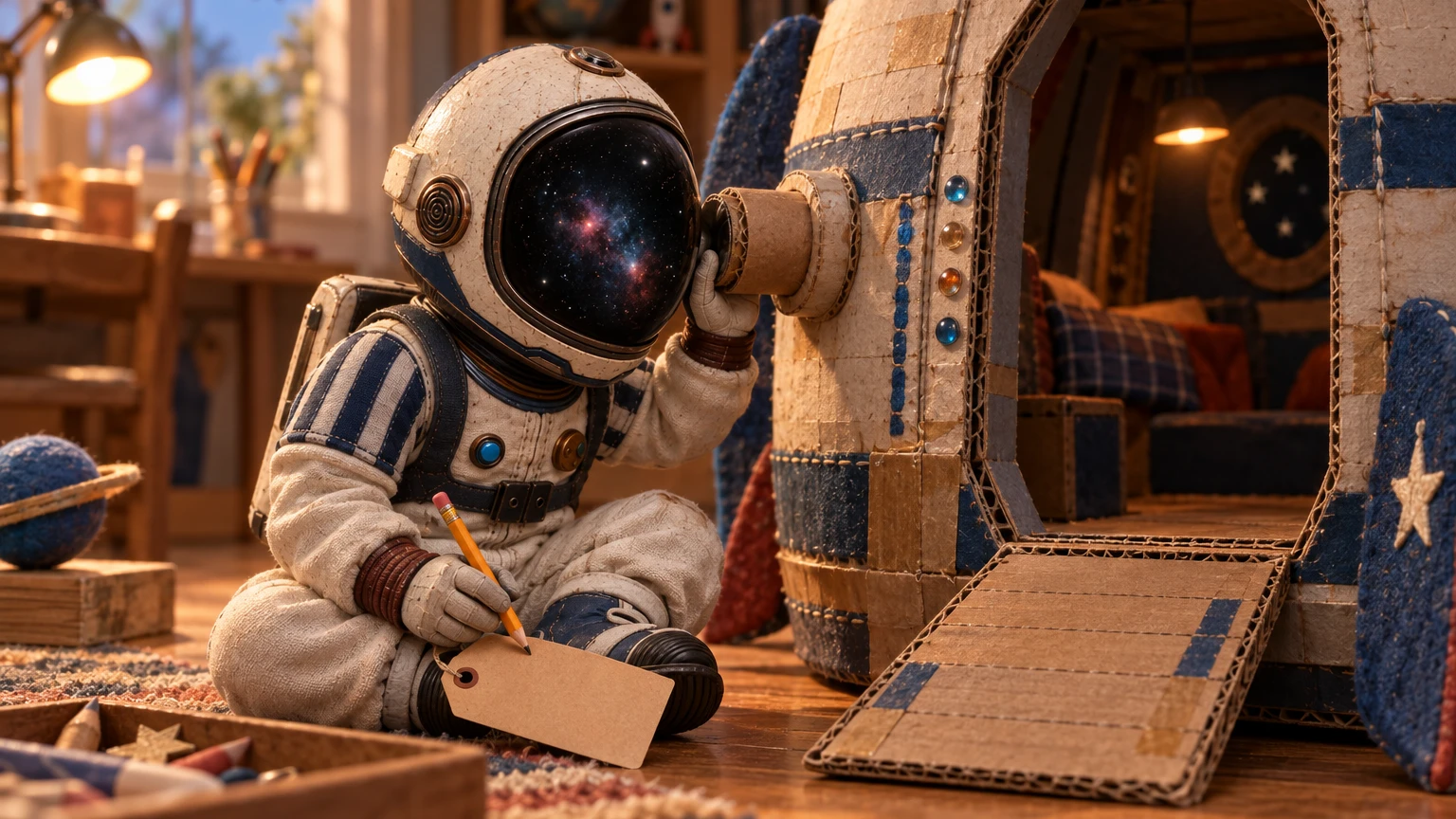
Imagine a child patting the side of a cardboard spaceship. “This is the Hushfold,” they announce, with the solemnity of a harbor master. You catch only half the name.
It is worth getting the other half. Before supplying a mission for the ship, listen for the story the child may already be telling through its name. You have something specific to ask about, and the child has something of their own to explain.
Early childhood storytelling guidance describes asking whether a child’s story has a title, recording the child’s exact words, asking clarifying questions, rereading the story, and avoiding edits to grammar or language.[1] The National Council of Teachers of English likewise describes family talk, play, drawing, storytelling, and early writing as ways children communicate and compose meaning.[2] These practices offer a useful starting point: give the child’s wording your attention before adding your own.
Learn how to say it
At the cardboard ship, you ask, “Can you say it once more? I missed the end.”
“Hush-fold,” the child says, whispering the first half. You try it that way. “Yes. Like that.”
Repeating the name gives the child a chance to correct what you heard. Its meaning can wait while you learn its sound.
If the child wants it written down, write today’s version. Early childhood storytelling guidance specifically values recording children’s exact words rather than tidying them into adult language.[1] A made-up spaceship name may change tomorrow; today’s version can remain a record of this flight.
Ask whether the name fits the ship’s work
Once you can say Hushfold, you ask, “Does that name have anything to do with what the ship does?”
“It folds storms,” the child says. “Small enough for the cupboard. The hush is so they stay asleep.”
Now the ship has a job, and the whisper has a purpose. It may be nonsense to you and exact inside the game.
Research on children naming novel artifacts found that four-year-olds who knew an object’s intended function produced more function-based invented names than perception-based names, while children who did not know the function relied more often on perceptual features.[4] These were laboratory tasks with novel objects; the finding cannot establish how a particular child names a spaceship at home.[4] It makes function a reasonable possibility to ask about, without making it the explanation you should expect.
Our imagined child has an answer ready. There may be no explanation yet in another conversation. You can keep using the name without getting one.
Learn the rules you have joined
You whisper the ship’s name again. The child corrects you: “You can say it loud out here. Only whisper when you’re inside.”
“Will the next person who comes aboard know that?” you ask.
“We have to tell them.”
The sound you first tried to copy now has a rule attached to it. In this imagined game, learning the name includes learning when to whisper and who still needs the briefing.
A 2022 study of three-year-olds found that children expected pretend object identities to be known by partners who had participated in the pretend episode; the researchers describe pretend stipulations as context-dependent.[3] The study involved Hungarian preschoolers in a laboratory task about object identity and partner knowledge, which limits its application to family storytelling.[3]
The Hushfold conversation extends that question of shared knowledge to an invented rule. The practical suggestion is modest: when joining the play, ask about an agreement you do not yet understand. Then use the answer. Here, you can lower your voice aboard the ship and leave the next passenger’s briefing to the child.
Give the answers a place in the play
The useful part of this exchange is what happens after the questions. You know enough to take a place aboard the Hushfold. There is no need to collect a complete account of its universe before the flight can begin.
None of the sources here directly studies conversations about invented spaceship names. A major review of pretend-play research concluded that existing evidence did not support strong causal claims about pretend play’s unique importance for broad developmental outcomes, and called for more and better evidence.[5] Its scope was pretend play broadly; it cannot establish that this particular exchange improves literacy, creativity, or intelligence.[5]
On a busy day, repeating the name may be the whole exchange. When there is time to stay, try using an answer in the play before reaching for another question.
Back at the Hushfold, you lower your voice as you take your place aboard. The child points to the cupboard. “That one’s still awake.”
Learn to say the name, then follow one detail the child offers. Put the answer to use in the game; an explanation of the whole imaginary world can wait.
Sources & further reading
- Listening to Children's Stories · National Association for the Education of Young Children
- Parents as Partners in Promoting Writing among Children and Youth · National Council of Teachers of English
- Young children expect pretend object identities to be known only by their partners in joint pretence · British Journal of Developmental Psychology / PubMed Central
- The sources of young children's name innovations for novel artifacts · Journal of Child Language / Cambridge University Press
- The Impact of Pretend Play on Children's Development: A Review of the Evidence · Psychological Bulletin / American Psychological Association; Drexel University repository record
Created with AI-assisted research and writing, with editorial and source checks. The illustration is an imagined scene.