More than one way into a story.
 4 min readUpdated
Who gets to answer?
Picture a group finishing a story about a river that has lost its way. One child has a long explanation. Another draws a bend in the water. A third points to the mountain where the trouble began.
If the only invitation is “Put up your hand and tell us,” two of those responses may never reach the group.
Keep the question; offer more ways to answer. What matters is whether a child has a way to contribute to the idea you are exploring.
CAST’s Universal Design for Learning guidelines make this distinction explicit: there is no single form of action and expression that is best for every learner. Preferences and the demands of the task can change with the context. [1]
Decide what you want to explore.
Start with the purpose of the conversation. Are you wondering where a character should go next? Comparing two possible endings? Trying to understand why someone left?
For a question about where the adventure goes next, you might say, “You can tell us, point to a place in the picture, or draw somewhere new.” Each route answers the same question.
This does not make every task interchangeable. If you are teaching a particular skill, such as handwriting, the method itself may be part of the goal. CAST’s guidance makes that qualification before recommending a range of media, including speech, drawing, movement and physical models. [2]
For this story conversation, though, you can choose a goal that leaves room for different kinds of contribution. You do not need to turn every idea into a spoken presentation before it counts.
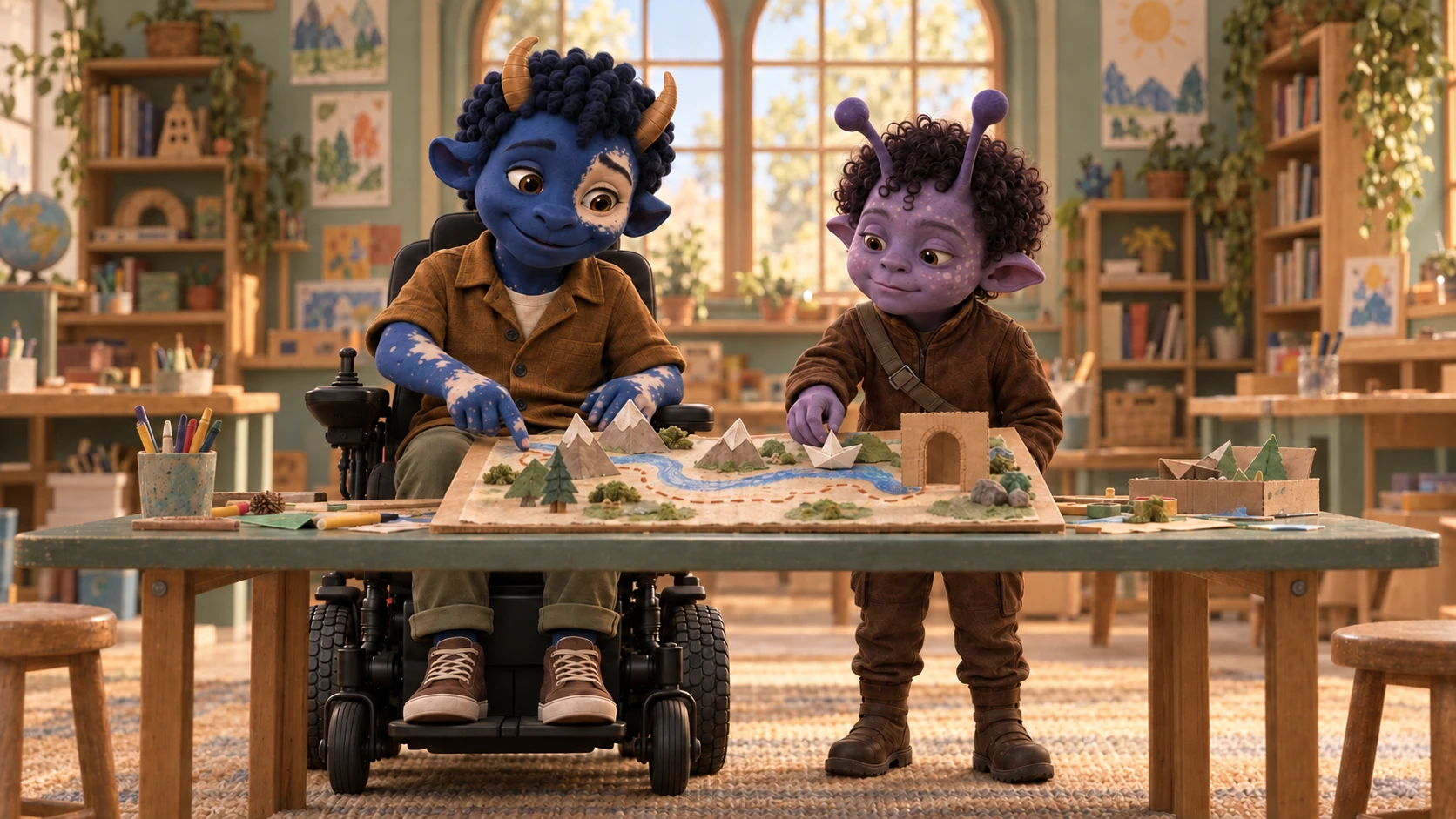
Make a map that needs more than one person.
Try this after a story with a journey: put a large sheet of paper where everyone taking part can reach it, or use smaller sheets that you can bring together.
Draw a starting place. Then ask, “Where could they go from here?” Someone might add a hill. Someone else might point to a blank corner and ask you to draw a lake. Another child could move a paper boat along the route.
If you write or draw for a child, check your interpretation: “Have I put the lake where you meant?” Leave room for correction. Your drawing is helping carry their idea.
Then connect the contributions. “The boat has reached this mountain. How could it get past?” A child who drew earlier might answer aloud this time. Someone who has been watching may decide to move the boat.
The map is one way to try that approach. NAEYC’s early childhood guidance recommends planning multiple ways to engage, represent ideas and express understanding, and using images and gestures as well as language. [3]
Keep the choices open.
Avoid handing out permanent roles: the talker, the artist, the quiet one. Offer the choices again the next time you read. A child can draw today and dictate tomorrow.
Listen to the contribution before judging the form. A roughly drawn tunnel may be exactly the solution the group needs. Ask what it does before deciding what it looks like.
CAST also asks educators to examine which forms of communication they value and which they dismiss. [4] For a story group, a useful self-check is whether you respond to a pointed finger with the same interest you bring to a full sentence.
Offer company without insisting on a performance. “Would you like to show me first?” gives a child a smaller audience. “You can watch for now” leaves the invitation open. Keep checking what would make joining in easier rather than deciding what their silence means.
Let their ideas change the shared story.
The test of this invitation is what happens to the answers. If every contribution is acknowledged and then the adult returns to the route they had already planned, the children have had very little say.
Let the drawn tunnel alter the journey. Let the pointed-out mountain become a problem worth discussing. Keep the impossible ending long enough to find out how its inventor thinks it works.
By the time the boat reaches the edge of the paper, the route should contain something you could not have planned alone.
Choose one question for the group, then offer two ways to answer it. Let their contributions shape what you make together.
Sources & further reading
Created with AI-assisted research and writing, with editorial and source checks. The illustration is an imagined scene.