You don’t need all the answers.
 3 min read
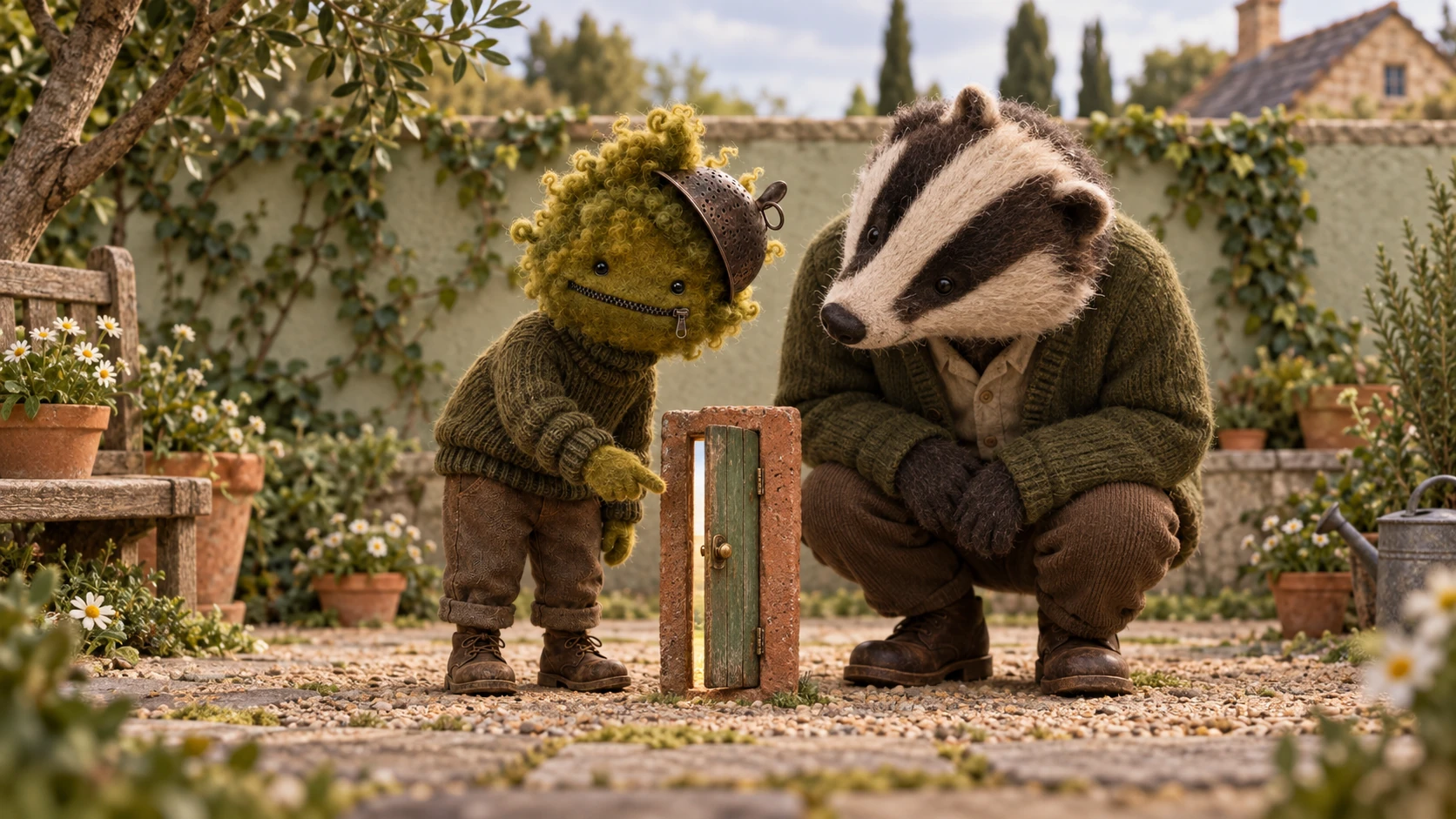
Leave the little door closed for a moment.
Imagine a tiny door in a story illustration. It sits at the foot of a tree, far from the path the main character is taking. The story never mentions it.
“Who lives there?” a child asks.
You could invent an answer straight away. Or you could look again: “I don’t know. What have you spotted?”
That pause leaves the question with both of you. There might be muddy footprints, a letter wedged underneath, or absolutely nothing to go on. You can wonder together without pretending the illustrator has supplied a solution.
This is the kind of conversation we want more room for during reading: an adult who is interested enough to ask, and willing to hear an answer they did not prepare.
Ask a question you actually want to hear answered.
Try “What did you notice?” when you are curious about what caught the child’s attention. Try “What do you think happens next?” when the story leaves a possibility hanging. Or point out your own uncertainty: “I can’t tell whether they want to go inside.”
You do not have to begin with the biggest question. “Where is the dog?” can be a pleasant invitation to look together. The difference is in what you do after the answer. Do you keep listening, or immediately move on to the next test?
In dialogic reading, an established form of interactive shared reading, the child takes a more active storytelling role while the adult listens and asks questions. The What Works Clearinghouse describes that exchange as central to the approach. [1]
These prompts borrow that invitation; they are not a complete dialogic-reading program.
Follow the answer before asking another question.
Suppose the child says the little door belongs to a giant. Resist supplying the obvious problem before they have had their say.
“A giant? Tell me about that.”
Perhaps the giant gets smaller on the doorstep. Perhaps the door is only for deliveries. Perhaps the child has already moved on to the bird in the tree. Any of those gives you something to respond to.
You can repeat a detail that interests you: “Only the giant’s letters fit through.” You can add your own possibility: “I thought it might be a tiny kitchen.” Let the child disagree.
Offer your own curiosity, too. Share an idea, then let it be changed.
Let a question wait.
If the child does not answer, leave a little space before rephrasing, narrowing the choices or answering yourself. You might offer your own observation and continue reading. They can return to the picture later.
There is no need for a question on every page. If the child asks you to carry on, carry on. A story can be absorbing without becoming a conversation at every turn.
Keep the distinction between an imagined answer and a factual one. “Maybe the giant shrinks” belongs to the story you are inventing. If the question becomes “Do real trees sleep?”, you can say you would like to find out and look for an explanation together later.
Saying “I don’t know” does not have to end the exchange. It can be an honest account of where the two of you are starting.
What the research supports.
There is evidence behind inviting children into shared reading. The What Works Clearinghouse’s 2007 review found positive effects of dialogic reading on preschool oral language, while finding no discernible effects on phonological processing. Those findings concern a studied reading practice, not the effect of one especially good question. [1]
A 2022 systematic review by Claire Pillinger and Emma Vardy likewise found encouraging evidence for language and literacy outcomes among children under five, while identifying methodological limitations and calling for stronger research into when the approach works best. [2]
That is a reason to value the exchange without keeping score at bedtime. These studies do not tell you how many questions tonight’s story needs, or whether a quiet reading session was worthwhile.
Choose a moment you are both interested in. Ask something you can stay curious about. Then see what the child makes of it.
The little door can remain a mystery until tomorrow.
At a moment that catches your interest, ask, “What do you think is happening here?” Listen to the answer before deciding whether to ask anything else.
Sources & further reading
- Dialogic Reading: Early Childhood Education · What Works Clearinghouse, Institute of Education Sciences
- The story so far: A systematic review of the dialogic reading literature · Journal of Research in Reading, UKLA; authors Claire Pillinger and Emma Vardy
Created with AI-assisted research and writing, with editorial and source checks. The illustration is an imagined scene.